


ADHD is one of the most common diagnoses families bring to us, and it’s easy to understand why it’s named what it is. “Attention deficit” puts the focus squarely on, well, attention. But a growing body of peer-reviewed research is asking families to look a little closer at what’s actually happening in the brain… and the answer may be more surprising than you’d expect.
Is Attention Really the Weakest Skill in the ADHD Brain?
Recent research published in the Journal of Mental Health and Clinical Psychology took a closer look at the cognitive profiles of individuals diagnosed with ADHD. Researchers compared attention levels to other core cognitive skills,including processing speed and working memory, and found something unexpected: attention was rarely the lowest-scoring skill.
Instead, processing speed and working memory were more often the weaker links. In other words, attention may frequently be a symptom of other cognitive weaknesses, rather than the root issue itself.
Why a Slow “Processor” Can Look Like an Attention Problem
Think of processing speed as the brain’s engine speed. When that engine runs slower than it needs to, a student has to work much harder just to keep pace with a lesson, a conversation, or a worksheet. That extra mental effort is exhausting, and exhaustion makes it difficult to sustain focus. The result can look exactly like an attention problem, even when attention isn’t the weakest skill at all.
Addressing the Symptom vs. Strengthening the Source
Attention is a skill that can be trained. While we do not treat or diagnose ADHD, our programs have improved the cognitive performance of clients with many diagnoses, including ADHD.
Many of the strategies families try first, like classroom accommodations, are designed to help a student work around a weak skill rather than strengthen it. Extra time on a test or a quieter workspace can offer real, short-term relief. But accommodations don’t build the underlying skill itself, which means the same struggle tends to resurface in new settings, year after year.
What “Strengthening the Source” Looks Like
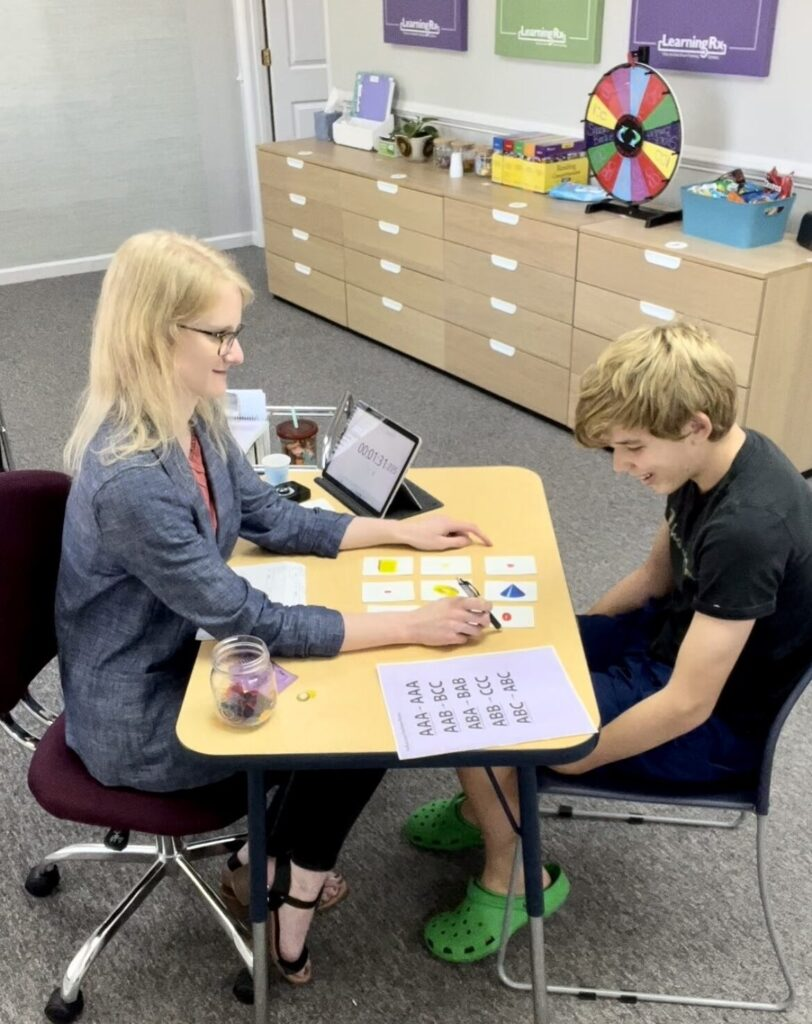
LearningRx Chattanooga East takes a different approach. Instead of working around weak cognitive skills, our one-on-one brain training programs are designed to target and strengthen them directly– including attention, processing speed, and memory. Clients work face-to-face with a personal brain trainer through fast-paced, intentionally challenging mental exercises, session after session, building the kind of repetition and intensity that’s needed to make real gains.
What Client Results Show
Over a twelve-year period, more than 7,500 children and teens came to LearningRx with an ADHD diagnosis. We measured their cognitive performance before and after brain training, and here’s what we found:
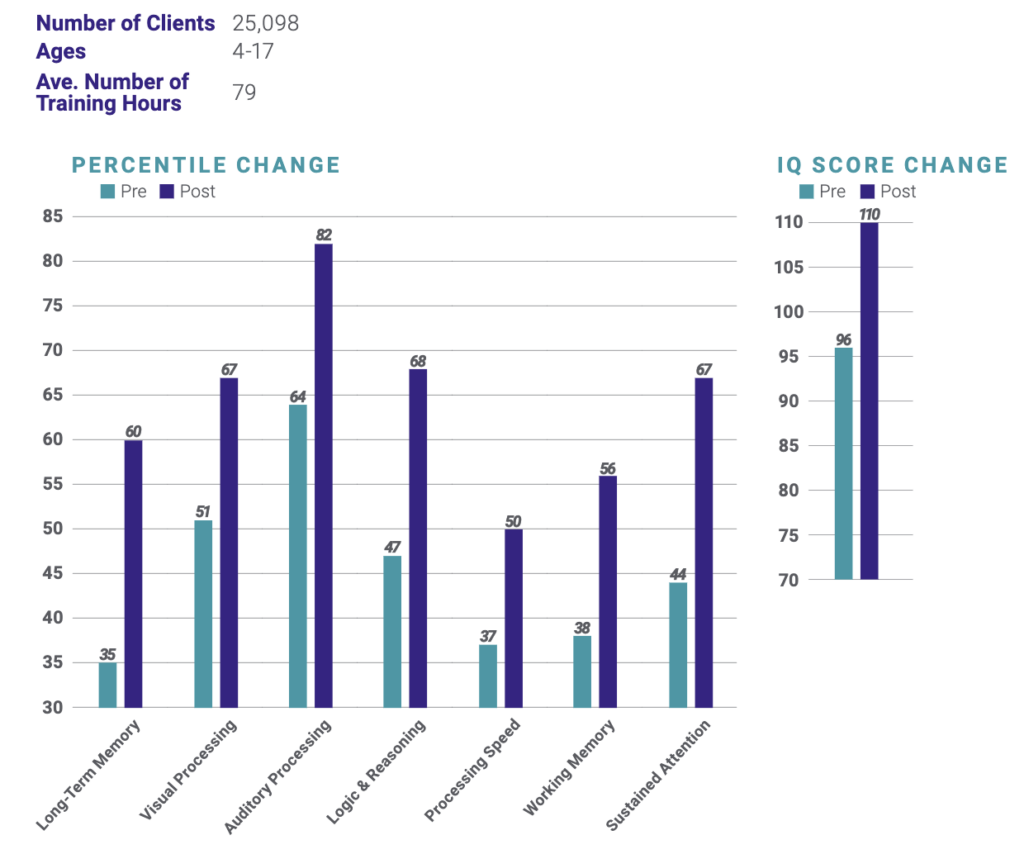
- Among clients ages 4–17 with ADHD, the largest improvements were seen in IQ, long-term memory, sustained attention, and auditory processing.
- Attention skills improved an average of 3.2 years after just 24 weeks of training.
- As a group, clients with ADHD started training with sustained attention skills averaging in the 42nd percentile, and finished averaging in the 65th percentile.
- A randomized controlled trial published in Neuropsychiatric Disease and Treatment (Moore, Carpenter, Ledbetter, & Miller, 2018) measured outcomes for children with attention problems who completed LearningRx training, and found an average IQ gain of 26 points along with improvements across cognitive skills, self-discipline, cooperative behavior, and confidence.
- In that same study, parents and children reported real-life changes such as staying on task longer, tuning out distractions, and focusing for longer stretches of time on difficult tasks.
Real Families, Real Change
“We have been attending LearningRx for a three months. My 9-year-old daughter can focus better and for longer periods of time. She also remembers things much better. We don’t have to keep relearning multiplication facts. My 14-year-old is more confident, motivated, and procrastinates less. I would recommend to anyone who is struggling.” – Sofie T., Chattanooga, TN
“My daughter recently completed their program and we couldn’t be happier with the results! At the start of the school year I didn’t know how we were going to manage and make it through she was struggling so badly despite being medicated for her ADHD. We tested and started the program in the early November and noticed results as soon as she was back in school from Christmas break in January. Her improvements continued as her standardized testing scores went up and most importantly her confidence and believing she could accomplish things on her own! Would do the program again in a heartbeat, the financial and time commitments are a small price to pay for something that can help my child for the rest of their life!” – Jennifer B., Chattanooga, TN
These figures and outcomes reflect past clients and published research. You or your child may or may not achieve the same results.
Is Your Child’s “Attention Problem” Something Else?
If your child’s attention struggles haven’t budged despite trying every accommodation in the book, it may be time to ask a different question: what’s really happening underneath the surface? A one-hour cognitive skills assessment can identify whether weak processing speed, memory, or other cognitive skills are contributing to the struggle… so you can address the source, not just the symptom.
Help your child strengthen their attention skills. Reach out to Learning Rx Chattanooga today.
📍Serving the Greater Chattanooga including East Brainerd, Shallowford, Ooltewah/Collegedale, Apison, Brainerd, East Ridge, Hixson, Belvoir/Germantown, and North Georgia
Sources
Moore, A.L., Carpenter, D.M., Ledbetter, C., & Miller, T. (2018). Clinician-delivered cognitive training for children with attention problems: Effects on cognition and behavior from the ThinkRx randomized controlled trial. Neuropsychiatric Disease and Treatment, 14, 1671–1683. doi: 10.2147/NDT.S165418
Additional findings referenced from peer-reviewed research published in the Journal of Mental Health and Clinical Psychology.