


It only takes a few seconds: type a prompt into any number of Ai chatbots, and a response appears. No searching, no struggling, no dead ends. It’s one of the most convenient shifts in how we work and learn. But it’s also raised a new question among researchers and educators alike: when we hand off the thinking, what happens to the brain that used to do it?
What Researchers Mean by “Cognitive Debt”
Is your AI habit creating “cognitive debt”? It’s a question scientists have actually been circling for well over a decade. Back in 2011, a Harvard-based study published in the journal Science found that when people expect information to stay just a search away, they tend to remember where to find it rather than the information itself– a pattern researchers nicknamed the “Google effect.” Scientific American and others have since covered how this kind of “cognitive offloading”, letting a tool carry the mental load instead of our own brain, has only accelerated as AI becomes more prevalent in schools, the workplace, and overall daily life.
Now, with AI chatbots in the mix, researchers are asking the same question with new urgency. A 2025 study from the MIT Media Lab compared brain activity and memory recall among people who completed a writing task unaided, with a search engine, and with ChatGPT. The pattern lined up with what offloading researchers have long suspected: the more the thinking got handed off to a tool, the less the brain’s own networks engaged (and the harder it was to remember the work afterward). Coverage of the findings has sparked a broader conversation about what daily convenience might be quietly costing us.
This research provides a timely reminder of something brain scientists have understood for a long time: skills that go unused tend to get weaker, while skills that are actively exercised tend to get stronger.
Why “Use It or Lose It” Still Applies to the Brain
While the topic of AI use in schools, the workplace, and day-to-day life continues to dominate daily discussions, the underlying concern remains: which mental skills are we exercising, and which ones are we letting go soft?
The Core Skills Behind Thinking, Learning, and Remembering
A handful of foundational cognitive skills do the heavy lifting behind nearly everything we do: reading, solving problems, following a conversation, or finishing a project without losing track of the steps. These include:
- Long-Term Memory– storing and retrieving information over time
- Working Memory– holding and using information in the moment
- Sustained Attention– staying focused on a task without drifting
- Processing Speed– how quickly the brain takes in and reacts to information
- Auditory Processing– making sense of what we hear
- Visual Processing– making sense of what we see
- Logic & Reasoning– connecting ideas and solving problems
These skills work together. When one is weak, everyday tasks, such as schoolwork, work projects, or even keeping up in conversation, can take more effort than they should.
Building Cognitive Skills Through One-on-One Brain Training
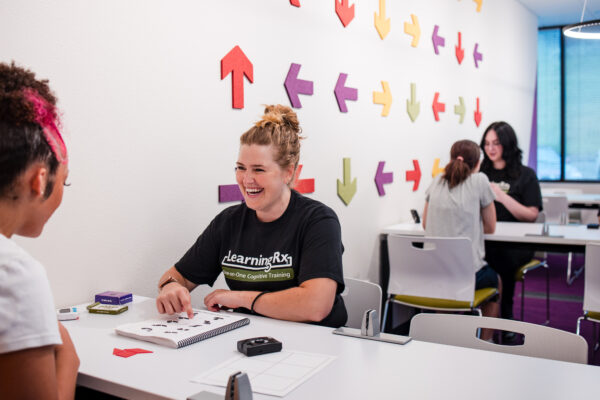
LearningRx Chattanooga works with children and adults of all ages to train cognitive skills, not by teaching new content but by strengthening the underlying mental skills the brain uses to learn, focus, and remember.
Each client is paired with a personal brain trainer for fun, challenging, one-on-one exercises designed to target their specific areas for growth, with a custom plan built around their results on a cognitive skills assessment.
You can check out brain training results from past clients here.
Building Brain Fitness Into Everyday Life
Technology isn’t going anywhere, and that’s not the point. The point is balance: making sure the brain still gets regular, active exercise alongside the convenience. A few simple habits can help:
- Try before you search. Give a problem your own best attempt before reaching for an AI tool or search engine.
- Practice retrieval. After reading, watching, or learning something new, try explaining it out loud or from memory before looking it back up.
- Protect device-free thinking time. Block out time for reading, puzzles, or planning without a screen nearby.
- Get curious about your own cognitive skills. A cognitive skills assessment can show which areas are strong and which could use extra support.
Curious How Your Cognitive Skills Are Performing?
Whether the goal is sharpening focus, supporting a student who’s struggling, or simply staying mentally sharp, the first step is understanding how the brain’s core skills are performing right now. A one-hour cognitive skills assessment at LearningRx Chattanooga provides a clear, personalized look at strengths and opportunities, and a training plan built around the results.
Schedule a Cognitive Skills Assessment today and find out how your brain’s core skills are performing. 👉Get Started
📍Serving the Greater Chattanooga including East Brainerd, Shallowford, Ooltewah/Collegedale, Apison, Brainerd, East Ridge, Hixson, Belvoir/Germantown, and North Georgia