
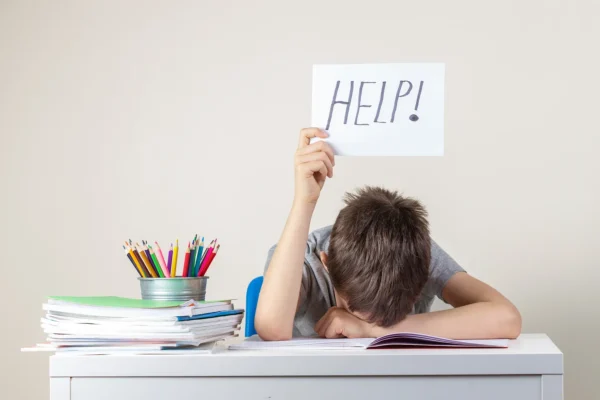

Homeschooling offers flexibility, freedom, and the ability to truly tailor learning to your child—but it can also come with moments that leave you wondering, “Why does everything feel so hard today?” If lessons that should be manageable suddenly lead to tears, shutdowns, or resistance, it may not be a motivation or behavior problem at all. What you may be seeing is cognitive overload—and recognizing it can completely change how you respond to tough homeschool days.
What Is Cognitive Overload?
Cognitive overload happens when the brain is asked to process more information than it can handle efficiently at one time. When this happens, learning slows down (or stops entirely).
This isn’t about intelligence or effort. A child can be bright, curious, and capable and still experience overload if certain underlying cognitive skills are underdeveloped or fatigued.
Think of it like this: If your child’s mental “bandwidth” is maxed out, even simple tasks can feel overwhelming and lead them to shut down.
Common Signs of Cognitive Overload in Homeschoolers
Cognitive overload doesn’t always look the same in every child, but many homeschooling families recognize these patterns:
1. Meltdowns During “Easy” Work
Your child understands the concept—but halfway through the lesson, emotions explode. This often points to challenges with:
Their brain may simply be so exhausted from holding and manipulating information that they literally run out of steam mid-task.
2. Sudden Resistance or Avoidance
Statements like:
- “I hate school.”
- “This is stupid.”
- “I can’t do this.”
are often signs of mental overload, not defiance. Avoidance is the brain’s way of protecting itself when it feels overwhelmed.
3. Forgetting What They Learned Yesterday
If your child understands something one day and seems to lose it the next, weak long-term memory or attention may be interfering with consolidation and retrieval.
This can be especially frustrating for homeschool parents who know their child “gets it” but don’t see them making progress.
4. Slow Work Pace or Mental Fatigue
When lessons drag on far longer than expected, it may not be a lack of effort. The real reason may be inefficient processing. Tasks that tax weak cognitive skills require more mental energy, leaving kids drained quickly.
5. Emotional Shutdown or Zoning Out
Some children don’t melt down; they disengage. Staring off, slumping, or giving minimal responses can be a sign that their cognitive load has exceeded capacity.
Reframing the Struggle: It’s Not a Behavior Problem
When kids are overloaded, behaviors are communication.
Instead of asking: “Why won’t they try harder?”
Try asking: “Which cognitive skill is being stretched beyond capacity right now?”
This shift removes blame (from both you and your child) and opens the door to real solutions.
How to Reduce Cognitive Overload at Home
While adjustments won’t “fix” underlying weaknesses, they can make learning more manageable. In the short term, you can try things like:
- Shortening lesson lengths and build in movement breaks
- Focusing on mastery over volume
- Reducing multi-step instructions
- Teaching one new concept at a time
- Watching closely for signs of fatigue before pushing through
These strategies support the brain. But if overload is a daily struggle, it may be time to look deeper.
When Extra Support Makes a Difference
At LearningRx Staunton–Harrisonburg, we help families understand why learning feels hard by identifying strengths and weaknesses in core cognitive skills like memory, attention, processing speed, and reasoning.
Instead of piling on curriculum changes, we strengthen the brain skills that make learning easier across all subjects.
When those skills improve, parents and students have noticed things like:
- Schoolwork getting done faster
- Fewer meltdowns
- Better retention
- Increased confidence and independence
You’re Not Doing It Wrong
Hard homeschool days don’t mean you’ve failed, that homeschooling isn’t the “right fit,” or that your child isn’t capable. They often mean the brain is working harder than it should.
Understanding cognitive overload gives you clarity, compassion, and a path forward.
If you’re ready to uncover what’s driving the struggle, LearningRx Staunton–Harrisonburg is here to help. Click here to get started with us today.
*Results are from past clients. Individual outcomes may vary, but you can read more about our research and results here!
We’ve always said that our son “just didn’t learn the same of most kids”. We knew he was so smart, but just didn’t fit the mold that public schools set forth. We started LearningRx in Harrisonburg just to try and catch him up in school and find the learning style that worked for him. We discovered so much more! We learned WHY he learns the way he does, we received support in our child study program meetings at school, and they even suggested we look in to a possible vision deficiency which led us to discover a diagnosed, often overlooked, eye condition. Milly and Sandy are truly amazing. We miss them! This program is worth the money and time. Its a commitment but your child/adult will benefit greatly and that is priceless.
~Ren O., Harrisonburg, VA
*Results based on past client; you or your child may or may not achieve the same results.