
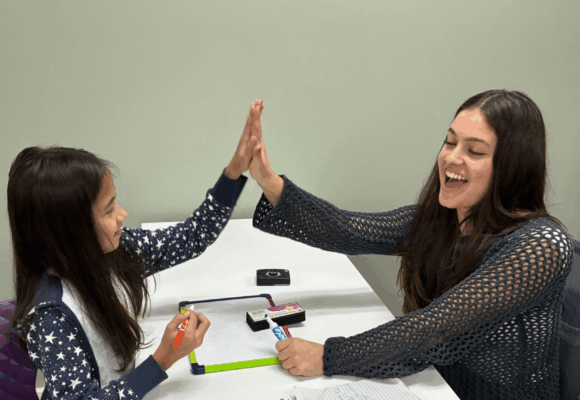

Want an easy way to boost your child’s thinking skills—without turning it into schoolwork? You don’t need worksheets or fancy tools. You just need a few minutes a day, a playful attitude, and some everyday items from around the house.
These simple, screen-free activities exercise the brain skills that make learning easier—like memory, attention, logic, and processing speed.
1. Memory Builders: “What Did You Hear?”
Say a short list of words aloud—like dog, banana, bike, shoe. Then have your child repeat them back to you. Once that’s easy, make the list longer or say the words faster.
👉 Why it helps: This builds auditory memory, a key skill for following directions and understanding spoken information in class.
📈Take it to the next level: engage working memory even more by having your kids give back the list in a different order! (Backwards, 2nd-3rd-1st-4th, etc.)
2. Beat the Timer!
Choose a quick challenge like stacking cups, lining up crayons by color, or matching socks. Use a timer and see how many they can complete in 30 seconds. Then try again to beat their score.
👉 Why it helps: Timed games strengthen processing speed—the brain’s ability to take in information, make sense of it, and respond quickly.
3. “I Spy… With a Twist” for Attention Skills
Play the classic “I Spy” game, but add categories: “I spy something blue that makes noise” or “I spy something small you can eat.”
👉 Why it helps: This version requires kids to pay attention to multiple details at once, boosting focus and flexible thinking.
4. Build It from Memory
Show your child a simple LEGO structure or block tower. Let them study it for 20 seconds, then take it apart and ask them to rebuild it from memory.
👉 Why it helps: This activity strengthens visual-spatial memory and attention to detail, both of which support strong learning skills in areas like math and executive function.
5. “Would You Rather?” for Reasoning Skills
Ask fun, thought-provoking “Would you rather” questions like:
- Would you rather have the ability to fly or be invisible?
- Would you rather live on the moon or underwater?
The key is to encourage your child to explain why they chose their answer.
👉 Why it helps: Talking through reasoning helps kids practice critical thinking and verbal expression, while also building confidence in sharing their ideas.
6. Mind-Body Challenges
Play games that mix movement with thinking, like:
- Counting backward while hopping on one foot
- Red Light Green Light
- Simon Says
- Doing jumping jacks while spelling words aloud
👉 Why it helps: Combining movement and mental tasks improves attention, working memory, and inhibitory control, making it easier for kids to control their focus.
Everyday Play = Real Brain Growth
You don’t always have to carve out extra time for “learning.” Just look for chances to sneak brain-boosting fun into your family’s daily routine. The more your child practices thinking skills in playful ways, the stronger those skills become!
Download our FREE Game Pack for More Brain-Strengthening Games You Can Try at Home!
At LearningRx Irvine, we help kids strengthen the core brain skills that make learning, reading, and paying attention easier. Our one-on-one brain training programs are backed by research and results—and parents love seeing the real-life changes that happen outside of sessions, too.
Get Started with LearningRx
Learning RX changed our lives! Leanne and Viktoria were the answered prayers for all our son’s struggles. After years of unanswered testing and labeling we were finally able to get the help our son needed. I can’t recommend this place enough. Life changing. Our son is now thriving and able to succeed in life as intended. Every learning disability and road block was helped and we found success!!!! Forever grateful. My son loved going twice a week. We called his lessons (Braingames) and each week he was more motivated, focused and had a huge confidence boost. I have a new son who is excited about learning now and everything they do here really works. Don’t hesitate to get help or tested and see what they can do for your needs!!!
~ Kristina H., Costa Mesa, CA
*Results based on past client; you or your child may or may not achieve the same results.