
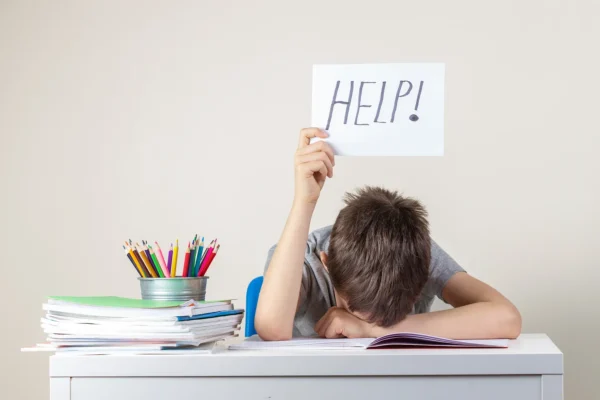

Every child gets distracted sometimes. They stare out the window during math… forget what you asked them to do… lose track of their backpack again. For most kids, these moments are part of growing up. But when does normal distractibility become an attention problem?
For some families, distractibility becomes a daily battle—impacting homework, mornings at home, evenings after school, and a child’s confidence along the way.
At LearningRx Reston, we talk with many parents who feel stuck between “maybe this will get better on its own” and “I’m worried my child is struggling more than they should.” If that’s you, you’re not alone.
Let’s break down the difference between normal distractibility and attention struggles that may need extra support.
Normal Distractibility: The Kind Most Kids Outgrow
You’re likely seeing typical development when your child:
- Gets distracted during tasks that are boring or repetitive
- Occasionally forgets instructions or needs a reminder
- Gets fidgety after sitting for a long time
- Loses track of personal items now and then
- Has trouble focusing when they’re tired or hungry
These kids can usually refocus with a prompt, and their distractibility isn’t causing major academic problems or emotional stress.
Signs of Deeper Attention Struggles
Attention challenges often show up long before a parent or teacher uses words like “ADHD.” You may be seeing deeper difficulties if your child:
Everyday Life
- Needs constant reminders—multiple times—for even simple tasks
- Seems mentally “somewhere else” during conversations
- Starts chores or homework but rarely finishes without a lot of supervision or hovering
- Burns a lot of effort just trying to stay on track
School
- Misses directions even when they were listening
- Makes “careless” mistakes that don’t match their ability
- Struggles to follow multi-step instructions
- Works much slower than classmates
- Has strong ideas but can’t get them down on paper
Emotional Signs
- Melts down over homework because it feels impossible to stay focused
- Calls themselves “dumb,” “lazy,” or “bad at school”
- Avoids tasks that require sustained thinking
- Gets overwhelmed quickly, even with help
When everyday tasks feel hard for your child—and stressful for you—it may be more than distractibility.
Why Attention Struggles Happen (It’s Not Always Just “Attention”)
Most parents assume focus problems = attention problems. But here’s the surprising truth:
Struggles with focusing, staying on track, or following through can actually be signs of weaknesses in other cognitive skills, such as:
- Working memory (holding information in mind)
- Processing speed (how quickly the brain takes in and uses information)
- Auditory or visual processing (accurately processing visual or auditory input)
- Executive function (planning and organizing, inhibitory control)
When one of these foundational skills is weak, inattention becomes the visible symptom, not the root cause.
This is why some kids try incredibly hard—and still fall behind.
You Don’t Have to Guess What’s Going On
At LearningRx Reston, we help families uncover the why behind attention struggles. Our one-on-one cognitive skills assessment looks at the brain skills that support focus—not just attention itself.
Because if your child’s difficulties are rooted in working memory, processing speed, or other cognitive skills…
no amount of time, reminders, or behavior charts will fix it.
Worried It’s More Than Distractibility? Let’s Talk.
You don’t have to wait, wonder, or hope it gets better on its own.
Contact LearningRx Reston to schedule a cognitive skills assessment and get clear insight into what’s beneath your child’s attention challenges—so you can take action that actually helps.
Your child isn’t “unfocused.” Their brain may just need a boost. We’re here to help!
I really loved the program for my three children. They all had some form of learning disability and this program was life changing for them. I saw a change on all three of them. I am so glad to see my dyslexic daughter not struggling as much and not switching letters any more. She no longer gets low grades in language arts and she now loves to read. My eldest one used to be easily distracted and had such low memory skills. Now I see her making friends, eating lunch with her sisters and socializing more. I also rely on her to remember where I put my keys and my phone:). The staff has also helped me a lot with their IEPs. I had an amazing experience and most of all, I loved the results!!!
~Beimnet E., Reston, VA
*Results based on past client; you or your child may or may not achieve the same results.